Maitreyi Paradigm- The Art and Science of Being Happy
  • Home
  • Maitreyi
    • Artistic Expressions
    • The Yogini Journey
    • Magical Paradigm
    • Blog
    • Contact Me
  • Ascension
    • Ascension Insights
    • Energy Dimensions
    • Quantum Ascension
  • Himalayan Masters
    • Ashtanga Yoga
    • Sounds and Music
    • Vedic Wisdom
  • Self-Discovery Journals
    • Books
    • Everyday Use Journal-Notebooks
  • Healing
    • Arts and Crafts
    • Daily Inspiration
  • Magic
    • Crystal Energy
    • Natural Mysticism
    • Inspired Living
  • Lifestyle
    • Green Living
    • Wellness

Which ragas are useful to heal different physical or emotional ailments?

8/22/2023

0 Comments

 
In Indian classical music, ragas are specific melodic structures that are considered to evoke certain emotions and feelings in listeners. While there is no scientific evidence that specific ragas can heal physical or emotional ailments, many people believe in the therapeutic power of ragas.

Here are a few examples of Hindustani ragas and the emotional responses they are traditionally believed to evoke:
  1. Raga Bhairavi: Often played in the early morning hours, this raga is known for its serene and devotional nature. It is said to help create an atmosphere of calm and peace, evoking feelings of devotion and surrender.
  2. Raga Yaman: This raga is known for its uplifting and joyous nature. It is played in the evening and is said to help elevate one's mood and inspire a sense of contentment and joy.
  3. Raga Darbari: This raga is known for its deep and soulful nature. Often used to evoke feelings of introspection and contemplation, it is believed to be particularly effective in helping to alleviate feelings of sadness and melancholy.
  4. Raga Malkauns: This raga is known for its serene and calming nature. It is said to help relax the mind and body, and is often used to help with insomnia.
  5. Raga Shree: This raga is known for its majestic and regal nature. It is said to help boost confidence and self-esteem.
  6. Raga Neelambari: This raga is believed to have a soothing and calming effect, making it an excellent choice for inducing peaceful sleep. It is said to help relax the mind and body, and is often used to help with insomnia.
  7. Raga Bageshri: Known for its romantic and sentimental nature, this raga is said to evoke feelings of love and longing. It is often used to help alleviate feelings of loneliness and heartache.
  8. Raga Todi: This raga is known for its melancholic and introspective nature. It is said to help evoke feelings of introspection and contemplation, making it a good choice for times of reflection and self-discovery.
  9. Raga Hamsadhwani: This raga is known for its joyous and uplifting nature. It is said to help elevate one's mood and inspire a sense of happiness and contentment.
  10. Raga Bihag: This raga is known for its romantic and passionate nature. It is said to evoke feelings of love and desire, making it a good choice for times of romance and intimacy.
It is important to note that the effects of music therapy, including the use of ragas, can vary greatly from person to person. While some people may find certain ragas to be healing or calming, others may not experience the same effects.

Furthermore, music therapy should not be used as a replacement for traditional medical treatments. If you are interested in using music as a therapeutic tool, it may be helpful to work with a certified music therapist who can tailor a treatment plan to your specific needs and preferences.
As always, consult with a healthcare professional before making any changes to your treatment plan. Music can be a powerful tool for self-expression and emotional healing, but it should be used in conjunction with other forms of therapy and medical treatment.

0 Comments

Raga Yaman, a sampurna raga for twilight time

5/12/2023

0 Comments


​Introduction

Raga Yaman, also known as Kalyani in the Carnatic tradition, is one of the most popular and well-loved ragas in Indian classical music.

It holds a special place in the hearts of musicians and listeners alike due to its melodic charm and versatility. Raga Yaman is characterized by its soothing and serene nature, often evoking a sense of peace and tranquility in the listener.

​It is a raga that is deeply rooted in the traditions of both Hindustani and 
​Carnatic music, making it a fundamental part of the Indian classical music repertoire.

​Raga Yaman- music to express love, devotion and longing

Raga Yaman is considered a sampurna raga, which means it consists of all seven swaras or notes - Sa, Re, Ga, Ma, Pa, Dha, and Ni.

​The raga is traditionally performed in the evening, as it is believed to be associated with the twilight hours, when the sun sets and day transitions into night. This association with the evening lends the raga a sense of introspection, making it ideal for expressing emotions such as love, devotion, and longing.
Picture
In Raga Yaman, the notes follow a specific ascending and descending pattern, giving the raga its unique structure and melodic identity.

The ascending sequence of notes, or arohana, in Yaman is: Sa, Re, Ga, Ma, Pa, Dha, Ni, and Sa. The descending sequence, or avarohana, is: Sa, Ni, Dha, Pa, Ma, Ga, Re, and Sa. One of the key features of this raga is the use of the teevra or sharp Ma, which lends a distinctive character to the melody. Additionally, the vadi, or the most important note, in Raga Yaman is Ga, while the samvadi, or the second most important note, is Ni.

Raga Yaman is known for its flexibility and adaptability, making it suitable for a variety of musical forms and styles. It is commonly featured in instrumental music, vocal music, as well as dance performances.

Musicians often choose to perform Raga Yaman in various forms such as khayal, thumri, ghazal, and even lighter genres like bhajans and film music. This versatility has helped to establish Raga Yaman as a favorite among both seasoned musicians and newcomers to Indian classical music.

The beauty of Raga Yaman lies not only in its melodic structure, but also in the emotional depth it offers to performers and listeners.

When rendered with skill and sensitivity, Raga Yaman has the power to transport the listener to a world of profound emotions and sublime beauty. This raga, with its unique combination of melody, rhythm, and emotion, continues to captivate audiences and inspire generations of musicians, making it an integral part of the rich tapestry of Indian classical music.
0 Comments

Ahir Bhairav, a soulful raga in Indian classical music

4/12/2023

0 Comments

 
​Ahir Bhairav is a popular and soulful raga in the world of Indian classical music. Although more commonly associated with the Hindustani classical music system, it has also found a place within the Carnatic music tradition.

The raga is known for its deeply emotive and introspective nature, making it a favorite among performers and connoisseurs alike.

​Delving into the characteristics and history of Ahir Bhairav provides an insight into its significance in the rich tradition of Indian classical music.
​In the context of Carnatic music, Ahir Bhairav is considered a janya raga (derived raga) and is often linked to the 20th Melakarta raga, Natabhairavi. The raga's structure is based on a set of seven swaras (notes), which are arranged in a specific order to create its unique melodic identity.

​The ascending scale (arohana) follows the pattern: Sa Ri1 Ga2 Ma1 Pa Dha1 Ni2 Sa, and the descending scale (avarohana) is Sa Ni2 Dha1 Pa Ma1 Ga2 Ri1 Sa.

Ahir Bhairav is particularly known for its deeply emotive and introspective nature, making it an ideal choice for compositions that evoke feelings of longing, devotion, and introspection. The raga is often associated with morning hours, and its somber and meditative qualities have a calming and soothing effect on listeners.
Picture
​The origins of Ahir Bhairav can be traced back to the ancient musical treatises, where it was mentioned as one of the ragas derived from the Bhairav thaat (parent scale) in Hindustani music. Over time, it has gained prominence and recognition in the Carnatic music system as well.

The raga's name itself, "Ahir Bhairav," is believed to be derived from the words "Ahir," denoting the pastoral community of India, and "Bhairav," a reference to Lord Shiva.

Several renowned composers and musicians have created moving compositions in Ahir Bhairav. In the Carnatic tradition, composers such as Muthuswami Dikshitar and Swathi Thirunal have contributed to the Ahir Bhairav repertoire, while the raga has also been extensively used by legendary Hindustani musicians like Pandit Ravi Shankar and Ustad Amir Khan.

In addition to its use in classical music, Ahir Bhairav has found a place in popular Indian film music, with many memorable songs composed in this raga. Its emotive and contemplative nature lends itself well to the expression of deep emotions and has inspired many composers to create beautiful melodies.

In conclusion, Ahir Bhairav is a captivating and significant raga within the realm of Indian classical music. Its introspective and emotive qualities have resonated with audiences and performers for centuries, and its rich repertoire of compositions continues to inspire and move listeners.

​As a testament to its enduring appeal, Ahir Bhairav has transcended the boundaries of classical music and found a place in popular culture, ensuring that its timeless melodies will continue to touch the hearts of music lovers for generations to come.
0 Comments

Nelaambari Raga in Indian Carnatic Music- a raga for relaxation and restful  soothing sleep...

3/27/2023

0 Comments


Nelaambari Raga- Introduction

​Nelaambari is a unique and enchanting raga in the realm of Indian Carnatic music. Known for its serene and calming nature, this raga holds a special place in the hearts of music connoisseurs and performers alike. Delving deeper into Nelaambari raga's characteristics and history provides a fascinating insight into its significance in the rich tapestry of Carnatic music.

Nelaambari raga belongs to the 29th Melakarta raga, Dheera Sankarabharanam, and shares the same swaras (notes) as its parent raga. 
​​The raga is often associated with lullabies and soothing melodies, making it an ideal choice for compositions that evoke feelings of peace, tranquility, and relaxation. The raga is also believed to have mystical healing properties, which adds to its allure and charm.

Structure of The Nelaambari Raga

The structure of Nelaambari raga is based on a set of seven swaras, which are arranged in a specific order, creating its distinctive melodic identity. The ascending scale (arohana) follows the pattern: Sa Ri2 Ga3 Ma1 Pa Dha2 Ni2 Sa, and the descending scale (avarohana) is Sa Ni2 Dha2 Pa Ma1 Ga3 Ri2 Sa. The use of vivadi swaras (dissonant notes) in Nelaambari raga is one of its striking features, giving it a unique melodic texture.

Nelaambari raga has an ancient history, with roots dating back to the time of the Natyashastra, a seminal treatise on performing arts written by the sage Bharata Muni. The raga has been mentioned in various ancient and medieval musical texts, signifying its importance and longevity in the tradition of Indian classical music.
Picture

Nelaambari Raga and other art forms

Over the centuries, several renowned composers and musicians have created soul-stirring compositions in Nelaambari raga. Nelaambari raga is also closely associated with dance forms such as Bharatanatyam and Kuchipudi. Its calming and emotive nature makes it an ideal choice for portraying emotions like devotion, love, and longing in dance performances.

In conclusion, Nelaambari raga is a fascinating and significant part of Indian Carnatic music. Its soothing and emotive characteristics have captivated audiences and performers for centuries.

​With a rich history and repertoire of compositions, Nelaambari raga continues to enchant music lovers and contribute to the vibrant tradition of Indian classical music. Its association with lullabies and healing properties further adds to its mystique and appeal, ensuring that Nelaambari raga will continue to inspire and soothe listeners for generations to come.
0 Comments

The Benefits of Chanting the Haum Shiva Mantra

9/3/2022

0 Comments

 
There are many benefits to reciting the Haum Shiva mantra. It is considered a powerful mantra that releases emotional pain. By chanting it, you make a connection with Shiva, and you connect with the higher frequency of the universe. If you are interested in learning more about this mantra, keep reading. 

First and foremost, do not confuse the mantra Haum with Hroum. Many people tend to use Hroum instead of Haum in longer Shiva mantras. Even though Hroum is also associated with Lord Shiva, still it has different energies associated with it and we will look at it in detail in another blog post.
​

Now coming back to Haum… The Haum mantra can be chanted anytime during the day, but it is most effective in the ‘stambha’ (stationary) period of Saturn, which is three to four days before and after Saturn goes retrograde. 
You can start to chant this mantra on any Saturday or Monday. You can also choose special Shiva days such as Shivaratri (special night of Lord Shiva), Full Moon and New Moon days as well as the Pradosha times, which can be easily noted from the Hindu lunar calendar or Panchang.
​

The Haum Shiva mantra is a blend of the Vata and Pitta ayurvedic humors (biological body types) . It stimulates all of your biological fires, including of the digestive system. It also strengthens the immune system and brings Divine love to your dwelling. It is also an effective mantra for the throat and vocal cords.
Haum bija mantra enhances the energies of the potent Shiva pranava ‘Aum’ with the ‘Ha’ sound. This added Ha sound gives it more fiery strength and prana to this bija mantra. Because of this, chanting Haum helps to enhance our vital… i.e., existential energies of our body. It helps to enhance our digestion and better our nutrient absorption. In general chanting Haum will help to better the nutrition assimilation of the foods you eat in our body.

Do keep in mind that though we are mainly speaking of physical foods that you consume, Haum bija mantra will also help you to effectively assimilate all the other ‘foods’ you consume. This can be in the form of mental impressions (movies, games, TV shows and so on) as well as life experiences in general. In this regard, Haum bija mantra can help you to better your ability to digest life experiences (positive or negative) and to strengthen your mind and enhance your mental health.
Chanting the Haum mantra on a daily basis will draw luck in all areas of your life, and you will feel an increase in your spiritual power. 

When chanting the Haum Shiva mantra, you are asking for the blessings from the cosmic deity- Lord Shiva. The Lord of the Universe, Shiva has three eyes and is the highest being. He governs time and has conquered death (which is the end of one’s time here on earth). Lord Shiva is able to grant us not only material comforts and benefits but also help us on our spiritual journey to attain enlightenment- i.e., understand the true nature of our reality.
​

Haum mantra will help you to manifest your dreams and desires. Just remember to always practice this mantra under the supervision of your guru, because it is highly powerful and should be chanted with proper care and with specific rigor.
Those of us who are aspiring to ascend, enlightenment is one of our key goals in life… and chanting Haum will help us to attain this ultimate state. So, if you are looking to enhance your spiritual journey, then you can chant Haum with devotion and receptivity and surrender your practice to the Divine- for it to be transmuted and transformed into something that will be for your highest good. 
​

The Haum Shiva mantra is an excellent choice for people who want to practice meditative practices and become more aware of the divine. Lord Shiva is a powerful deity and is a great source of inspiration. 
He is a supreme power, and we can worship him with reverence. There is no better way to be receptive to his teachings than daily chanting Haum. 

Connecting with this Shiva energy of Haum will make you feel blessed and liberating at the same time.  It will help you to gain inner insight into your own working and through that you will gain better insight into the workings of the world. Chanting Haum will help you to achieve self-mastery and through that you will also be able to become the ultimate master of your life. 

These are just some of the benefits of the Haum Shiva mantra. Once you start chanting this on a daily basis with deep commitment and devotion, you will be surprised at how powerful it can be.

also check out:

  • Why we celebrate Maha Shivaratri? i.e. The spiritual importance of celebrating 'The Great Night of Lord Shiva'
  • What are some of the healing benefits of Rudraksha? (from health standpoint)
  • ​Understanding the Shiva-Shakti family... Who is Lord Ganesh?
  • ​What do I do if I do not have any Spiritual Guru? - How can I still obtain Divine guidance and proceed on my spiritual path to ascension?​
Picture
0 Comments

Benefits of chanting the Kleem (Klim) bija mantra

8/30/2022

0 Comments

 
The Kleem bija mantra is very easy to chant. It is also written as Klim, though the correct pronunciation requires us to draw out the 'ee' sound. 

Chanting this amazingly simple mantra- Kleem, merely requires a focused mind and a pure heart. You can set up a specific chanting regimen where you set aside a particular time each day to do the chanting or you can even chant this mantra internally as you go about the day and as you carry out your daily activities.
Kleem is the bija of 'attraction" and 'delight'. Chanting Kleem helps us to connect with the positive and joyful energies of the universe.

Chanting the Kleem mantra can help you overcome problems in relationships. It can bring back estranged relationships. It can help mend all kinds of relationships with family, friends, colleagues and so on. 

The energies of this mantra helps you to open up to the positivity and joy of sharing good, healthy bonds with others... an exchange that is based on purity of love and caring. ​
It helps you to attract positive relationships... where the interaction does not smother you with dependence and negativity but in fact liberates you even as you share a relationship with another being. 

Regular chanting of Kleem mantra can also help you deal with emotional problems such as low self-esteem, depression, and anxiety.

Chanting the Kleem mantra empowers your inner energy core to attract more material abundance and positive people. It helps in filling the void in your life and makes your relationships stronger and more fulfilling. It can also attract more better friendships and wealth. It can also be used to attract romance. However, it is important to believe in mantras as well as realize that Universe is perfect in its timing. 
Chanting mantras such as Kleem help you to dissolve, address the existing negative karmas associated with whatever it is that you are seeking. Since each one of us will have a different set of karmic baggage and our sincerity in chanting the mantra will also vary, we will each see varying results.

​This is why, instead of expecting immediate results (which do happen), it is best to sincerely and diligently continue with the chanting practice (sadhana) and patiently wait for the Universe to give you the positive results in due time.
When chanted correctly, the Kleem bija mantra will transform your mind and body. It will also help you with spiritual ascension journey, as it connects you to powerful energies of the Divine Mother and primal energies of the Goddess Kali and also with the pure consciousness energies of Lord Krishna.

also check out:

  • The two important bija (seed) mantras of Lord Ganesh
  • ​Aim is an important seed sound i.e., Bija Mantra for Ma Saraswati- the Goddess of Creativity and Intelligence
  • ​Kreem (also written as Krim) is an important seed sound, i.e. Bija Mantra for Ma Kali- the Goddess of Manifestation and Transformation
Picture
0 Comments

What is a "Mantra"?

3/9/2021

0 Comments

 
​“Mantras” are powerful syllables that is said to have revealed in the consciousness of ancient rishis which are capable of transforming one’s mind. Mantras form part of Vedas, chanted during auspicious occasions with the intention to praise the Gods and Goddesses. 

Just like the normal words creating the sound when uttered through mouth, mantras also create sound, but with a vibration affecting the internal chakras in the body. Certain cells in the body, are activated through this vibration.  This helps to control the mind by increasing the awareness and concentration. Chanting of mantras in its specific order brings the effect of Prayanam, a yogic practice of controlling the mind through breath control.  
Picture
​The breath is controlled with a consequence of rhythmic chanting of mantras formulated as slokas. This in effect activates the brain cells. Usually, mantras are combination of different words starting with the syllable “Aum”. There are different types of mantras creating various types of sounds. 

Chanting of some mantras create nasal sounds, several others are chanted by giving importance to certain letters in the mantra, etc. Mantras belong to Vedas – Rig, Yajur, Sama chanted based on several traditions. “Aum” is considered as the source of all the mantras in Hinduism. The sound is created with the help of the lips, tongue, jaws, nose and throat. This helps in the smooth flow of prana through the nadis (channels) related to these organs. 

When the pranic flow is smooth through these nadis, the brain cells gets activated by bringing a good control over the emotions of the mind. When the emotions are controlled, naturally, the greed, anger, lust that makes the man mad is also controlled and as a result, the individual who practice the mantra chanting starts to live in the world with harmony. 

Mind is transformed automatically through the channelizing of the pranic energy through the nadis. The individual gets a good balance over the positive and negative energies of the mind. Just like the sound produced by any musical instrument that soothes the human mind, mantras are also powerful in brining tranquility in the mind.  

If the mantras are chanted in a group, the persons who chant and persons who are present in the presence also get benefitted out of it.  Generally, mantras are initiated by Guru to a disciple depending on the favorite deity of the disciple.  Repeated chanting of mantra takes the disciple to spiritual heights. 
Categories: 
Vedic Sounds,    Vedic Science     and   Vedic Tradition

Keywords and Tags:
#mantra #Devotion #DevotionalMusic #BhaktiYoga #Hindu #Vedic #MaitreyiParadigm #Bhakti #Sadhana #Prayers #chanting #mantrachanting #vedicsounds   #nada   #laya
0 Comments

Kirtana- How the Yogic Path of Praise and Devotion can help you to commune with the Divine

1/19/2021

0 Comments

 
Kirtana has always played a major role within Bhakti Yoga- the Yogic path of Praise and Devotion. 

​Bhakti Yoga allows anyone and everyone to pray with love and faith. It is a community-singing experience that utilizes songs and music to feel close to the Divine! It does not require strict and often restricting principles and methods of the other two paths of Yoga- Jnana Yoga (Yogic path of Knowledge) or Karma Yoga (Yogic Path of Action).
Categories: 
Vedic Sounds,    Vedic Science    and   Vedic Tradition

Keywords and Tags:
#Kirtan #Devotion #DevotionalMusic #BhaktiYoga #Hindu #Vedic #MaitreyiParadigm #Bhakti #Sadhana #Prayers #Kirtana #Devotion
0 Comments

What is Nāda?

9/29/2017

0 Comments

 
What is Nāda? - Understanding the basics of sound energy 
​

It is a known fact that everything that can exist in the universe as a material form has a vibration associated with it. In ancient Vedic times, this vibration which is intrinsic to the body was called nāda.

In physics, sound is a vibration that typically propagates as an audible wave of pressure which requires a transmission medium. So, even in modern science, sound is considered as a form of vibrational energy which has longitudinal or compression wave pattern when it travels thru gaseous or liquid medium and a transverse wave pattern when it travels thru solid medium.

It is also a known scientific fact that as we lower the temperature of any material, the various motions of the molecule will be reduced, but we are not able to stop the vibrational motion of these molecules even at extremely low temperatures. i.e. Vibrational Energy is fundamental to existence of matter.
Picture
This is to say that vibrational motion continues to exist even as all other forms of motion are removed- i.e. all turbulence is removed, and the substance is at a state of stationary peace and tranquility.

Since nāda is fundamental to the existence of any form, it is considered as the very essence of that form. By tapping into this vibrational energy, the nāda of any form we can establish a direct contact with that form, which is not marred by external appearances which are typically based on linguistic and cultural biases.

​This forms the basis of Nāda Yoga indicated in Sanskrit as नादयोग, which is an ancient Vedic science of using Sound and associated breath to achieve a state of unison (yoga) within one’s own self as well as unison (yoga) with the Divine.
#NadaYoga #ScienceofSound   #VedicScience #soundhealing #soundtherapy  #VedicScience #nada #yogaspanda #spanda #energythread #energystrand #energyconnection
0 Comments

Kreem (also written as Krim) is an important seed sound, i.e. Bija Mantra for Ma Kali- the Goddess of Manifestation and Transformation

11/27/2016

0 Comments

 
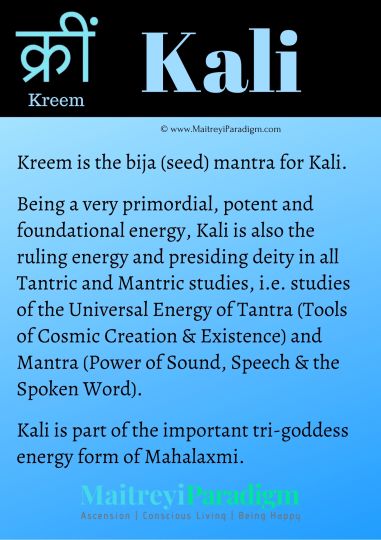
Kreem is the bija (seed) mantra for Kali. It is also sometimes written as Krim, though it needs to be noted that the "i/e" sound has a longer stretched pronunciation.

​Being a very primordial, potent and foundational energy, Kali is also considered as the ruling energy and presiding deity in all Tantric and Mantric studies, i.e. studies of the Universal Energy of Tantra (Tools of Cosmic Creation & Existence) and Mantra (Power of Sound, Speech & the Spoken Word). 

Since Kali is the basis of ‘manifestation’ of this created world from Pure Potentiality of Consciousness (Shiva), she represents the kinetic energy, governs actions and represents the very existentiality of a manifested (i.e. created) form.
PictureKreem is the bija (seed) mantra for Kali. It is also sometimes written as Krim, though it needs to be noted that the
Kali Bija Mantra- Krim or Kreem
Her energy is extremely potent and electrical in nature. Lightening energy is one of her expression and invoking her without proper understanding or guidance can be extremely dangerous which can sometimes lead to a "shocking" experience! 

She is also the adi-shakti (first primordial energy), first of the ten dasha-maha vidyas (ten wisdom Goddesses) and represents time. She is the time-axis of the space-time continuum of this existential world. 

Kali is part of the important tri-goddess energy form of Mahalaxmi.
Categories: 
Gods And Deities,   Vedic Sounds       and   Tantra Mantra Yantra

Keywords and Tags:
#KaliMantra #Shakti #Kali #Mantra #HinduGoddess #kreem #krim #BijaMantra #SeedSound #Mantrachanting #KaliMantra #BhaktiYoga #Hindu #Vedic #MaitreyiParadigm #Bhakti #Sadhana #Prayers #Kirtana #Devotion #Kali #ShaktiMantra
0 Comments

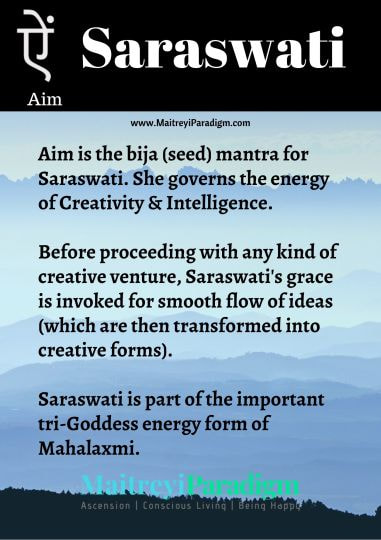
Aim is an important seed sound i.e., Bija Mantra for Ma Saraswati- the Goddess of Creativity and Intelligence

11/27/2016

0 Comments

 
Aim is the bija (seed) mantra for Saraswati. She governs the energy of Creativity & Intelligence. Ai (ऐ)stands for Saraswati and bindu (dot) indicates dispelling of sorrow. 
​
It indicates creation and creativity in all forms. It is the seed sound for success in spiritual, educational, and scientific endeavors. It is also the seed sound for all kinds of artistic and creative actions such as writing, visual arts, singing, dance and music. 
PictureAim is the bija (seed) mantra for Saraswati. She governs the energy of Creativity & Intelligence. Ai (ऐ)stands for Saraswati and bindu (dot) indicates dispelling of sorrow.   It indicates creation and creativity in all forms. It is the seed sound for success in spiritual, educational and scientific endeavors. It is also the seed sound for all kinds of artistic and creative actions such as writing, visual arts, singing, dance and music.   Before proceeding with any kind of creative venture, Saraswati's grace is invoked for smooth flow of ideas (which are then transformed into creative forms).  Since all of life is a form of
Saraswati Bija Mantra- Aim
Before proceeding with any kind of creative venture, Saraswati's grace is invoked for smooth flow of ideas (which are then transformed into creative forms).

Since all of life is a form of "creation", it is essential to obtain Saraswati's grace, so our actions are wise and timed appropriately. Because of this key attribute, she is one of the energy forms invoked at the onset of any venture (after Ganesh) and is part of the important tri-Goddess energy form of Mahalaxmi.
Categories: 
Gods And Deities,   Vedic Sounds       and   Tantra Mantra Yantra

Keywords and Tags:
#Saraswati #Shakti #Mantra #GoddessofEducation #HinduGoddess #BijaMantra #SeedSound #Mantrachanting #KaliMantra #BhaktiYoga #Hindu #Vedic #MaitreyiParadigm #Bhakti #Sadhana #Prayers #Kirtana #Devotion #ShaktiMantra
0 Comments

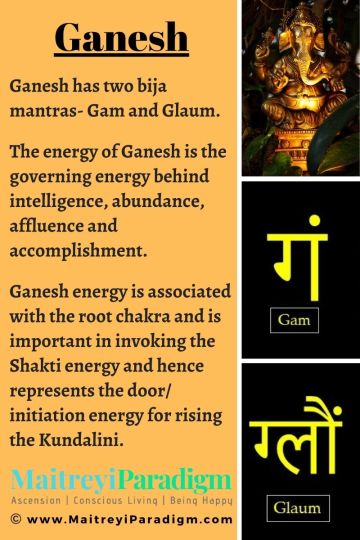
The two important bija (seed) mantras of Lord Ganesh

11/27/2016

0 Comments

 
Lord Ganesh has two bija mantras- Gam and Glaum. Bija mantras are the seed sounds of the deity and similar to any seed- it contains the potential existence of that deity within it.
​
Gam is the most important bija mantra and is part of the important Lord Ganesh mantra, Om Gam Ganapatey Namah.

Glaum on the other hand is more of a tantric bija mantra and is used in special instances which helps to remove major obstacles so that we can proceed with our usual Ganesh sadhana (prayers) using the Gam mantra.
PictureGanesh has two bija mantras- Gam and Glaum. Gam is the most important bija mantra and is part of the key mantra- Om Gam Ganapatey Namah.  Glaum on the other hand is more of a tantric bija mantra and is used in special instances which helps to remove major obstacles so that we can proceed with our usual Ganesh sadhana (prayers) using the Gam mantra.  The energy of Ganesh is the governing energy behind intelligence, abundance, affluence and accomplishment. In a way Ganesh signifies time (Kali truly represents time) since he gives out the fruits of karma. In addition, Ganesh energy also rules the Vedic sciences, particularly Vedic Astrology (Jyotish).  Ganesh energy is associated with the root chakra and is important in invoking the Shakti energy and hence represents the door/ initiation energy for rising the Kundalini.  Because Ganesh is also the key energy of this earth-plane and the ruler of the masses (Ganpati) along with
Ganesh Bija Mantra- Gam and Glaum
The energy of Ganesh is the governing energy behind intelligence, abundance, affluence, and accomplishment. In a way Ganesh signifies time (Kali truly represents time) since he gives out the fruits of karma. In addition, Ganesh energy also rules the Vedic sciences, particularly Vedic Astrology (Jyotish).
 
Lord Ganesh energy is associated with the root chakra and is important in invoking the Shakti energy and hence represents the door/ initiation energy for rising the Kundalini.
 
Because Lord Ganesh is also the key energy of this earth-plane and the ruler of the masses (Ganpati) along with "remover of obstacles" (Vignaharta), his energy is invoked before initiating any new task or journey for its smooth and successful completion

You may also want to check out...

  • Wisdom of Ganesh (who is Ganesh?)​
  • The Ganesh Energy
  • ​Shri Ganesh Aarti in Hindi (devnagri script) and other details in English
  • Tantric form of Lord Ganesh- Uchchhishta Ganapati
Categories: 
Gods And Deities,   Vedic Sounds       and   Tantra Mantra Yantra

Keywords and Tags:
#GaneshBijaMantra #Gam #Glaum #BijaMantra #SeedSound #Mantrachanting #GaneshMantra #BhaktiYoga #Hindu #Vedic #MaitreyiParadigm #Bhakti #Sadhana #Prayers #Kirtana #Devotion #Ganesha #GaneshaMantras #HinduGod #Ganesh
0 Comments
    Picture

    ... also check out
    ​our main Blog

    Picture

    Vedic Wisdom

    Categories

    All
    Aartis And Chalisas
    Arts From Bharat
    Festival Celebrations
    Gods And Deities
    GyanBites
    Help From Vedas
    Inspiring Quotations
    Jyotish For Ascension
    Myths And Beliefs
    Practical Ayurveda
    Prayers And Sadhanas
    Rishis And Sages
    Shloka For The Week
    Stories And Legends
    Tantra Mantra Yantra
    The Bhagavad Gita
    Thought Bytes
    Tools And Methods
    Vedic Archetypes
    Vedic Living
    Vedic Maths
    Vedic Philosophies
    Vedic Science
    Vedic Sounds
    Vedic Symbolism
    Vedic Teachings
    Vedic Technologies
    Vedic Texts
    Vedic Tradition
    Wisdom Bytes

    Picture
    Picture
    Vedic Culture, which   is the culture of the original Himalayan Masters,    is one of the most advanced ancient civilizations.  It is a tradition which has given mankind several treasures such Yoga, Meditation, Conscious-Living and Vedic Sciences such as Ayurveda, Vedic Physics & Vedic Mathematics.

    It was always a scientific culture that understood the very mechanics and workings of this Universe. Their deities, their gods and goddesses were all a way of expressing and explaining these energies and their inter-working. Modern Quantum Mechanics is just starting to understand string theory, dark matter etc. which have all been fundamental to the Vedic understanding. Because of this, they developed ways and methods which allowed one to best tap into life-energy itself.

    Vedic Culture, as it was practiced by the Himalayan Masters, was always a "way of life" and not a religion.

    Their basic view was that, there is only ONE Supreme God-head (God as our creator) and each one of us can find our path to it- experience union with that divinity (Yoga) in their own way.

    Because of this, anyone with any religious affiliations and beliefs can still benefit from their knowledgeable ways of Vedic Wisdom.

    Our attempt here is to present this ancient wisdom in a modern light, so our readers can interpret the true, essential meaning more easily and then extrapolate it to their own specific scenarios and enhance the quality of their life and being-ness.
    Check out Maitreyi's latest books...
    Picture
    Picture
    Picture
    Picture
    Picture
    Picture
    Picture
    Picture
    Picture
    Picture
    Picture
    Picture
    Picture
    Picture
    Picture
    Picture
    Picture
    Picture
    Picture
    Picture
    Picture
    Picture
    Picture
    Picture
    Picture
    Picture
    Picture
    Picture
    Picture
    Picture
    Picture
© Copyright 2025 Sandhya Bhat & ​Macro2Micro Media *** ALL RIGHTS RESERVED *** See Terms & Conditions for details on this site usage.